Tree is an important Data Abstraction for representing hierarchical relationships.
There we will consider a tree in a different perspective.
Definition
Recursive description (wooden trees):
A tree has a root label and a list of branches
Each branch is a tree
A tree with zero branches is called a leaf
Relative description (family trees):
Each location in a tree is called a node
Each node has a label that can be any value
One node can be the parent/child of another
People often refer to labels by their locations
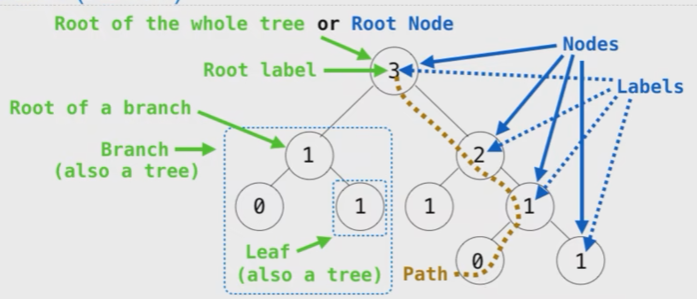
Constructor
def tree(label, branches=[]):
    for branch in branches:
        assert is_tree(branch), 'branches must be a tree'
    return [label] + list(branches)

def label(tree):
    return tree[0]

def branches(tree):
    return tree[1:]

def is_tree(tree):
    if type(tree) != list or len(tree) < 1:
        return False
    for branch in branches(tree):
        if not is_tree(branch):
            return False
    return True

def is_leaf(tree):
    return not branches(tree)
Tree processing
Functions that take trees as input or return trees as output are often tree recursive themselves.
- Processing a leaf is often the base case in a tree processing function.
- The recursive case typically makes a recursive call on each branch and then aggregates.
Example:
def count_leaves(t):
    """Count the leaves of a tree."""
    if is_leaf(t):
        return 1
    else:
        branch_counts = [count_leaves(b) for b in branches(t)]
        return sum(branch_counts)

def leaves(t):
    """"Return a list containing the leaf labels of tree."""
    if is_leaf(t):
        return [label(t)]
    else:
        branch_counts = [leaves(b) for b in branches(t)]
        return sum(branch_counts,[])
A function that creates a tree from another tree is typically also recursive
def increment_leaves(t):
    """Return a tree like t but with leaf labels incremented."""
    if is_leaf(t):
        return tree(label(t) + 1)
    else:
        bs = [increment_leaves(b) for b in branches(t)]
        return tree(label(t), bs)

def increment(t):
    """Return a tree like t but with all labels incremented."""
    return tree(label(t) + 1, [increment(b) for b in branches(t)])
def print_tree(t, indent=0):
print(' ' * indent + str(label(t)))
for b in branches(t):
print_tree(b, indent+1)
There’s another type of Recursive Functions, sometimes handy.
def print_sums(t, so_far):
    so_far = so_far + label(t)
    if is_leaf(t):
        print(so_far)
    else:
        for b in branches(t):
            print_sums(b, so_far)
Tree Class
class Tree:
    """A tree is a label and a list of branches."""
    def __init__(self, label, branches=[]):
        self.label = label
        for branch in branches:
            assert isinstance(branch, Tree)
        self.branches = list(branches)

    def __repr__(self):
        if self.branches:
            branch_str = ', ' + repr(self.branches)
        else:
            branch_str = ''
        return 'Tree({0}{1})'.format(repr(self.label), branch_str)

    def __str__(self):
        return '\n'.join(self.indented())

    def indented(self):
        lines = []
        for b in self.branches:
            for line in b.indented():
                lines.append('  ' + line)
        return [str(self.label)] + lines

    def is_leaf(self):
        return not self.branches


    def fib_tree(n):
        """A Fibonacci tree."""
        if n == 0 or n == 1:
            return Tree(n)
        else:
            left = fib_tree(n - 1)
            right = fib_tree(n - 2)
            fib_n = left.label + right.label
            return Tree(fib_n, [left, right])

    def leaves(t):
        """Return a list of leaf labels in Tree T."""
        if t.is_leaf():
            return [t.label]
        else:
            all_leaves = []
            for b in t.branches:
                all_leaves.extend(leaves(b))
            return all_leaves


    def height(t):
        """Return the number of transitions in the longest path in T."""
        if t.is_leaf():
            return 0
        else:
            return 1 + max([height(b) for b in t.branches])
Tree Mutation
    def prune(self, target):
        self.branches = [b for b in self.branches if b.label != target]
        for b in self.branches:
            prune(b, target)