Primitive Types
byteshortintlongfloatdoublebooleanchar
Reference Types
Everything not belonging to [[#Primitive_Types.md|#Primitive_Types]] is a reference type, including arrays.
Class instantiation
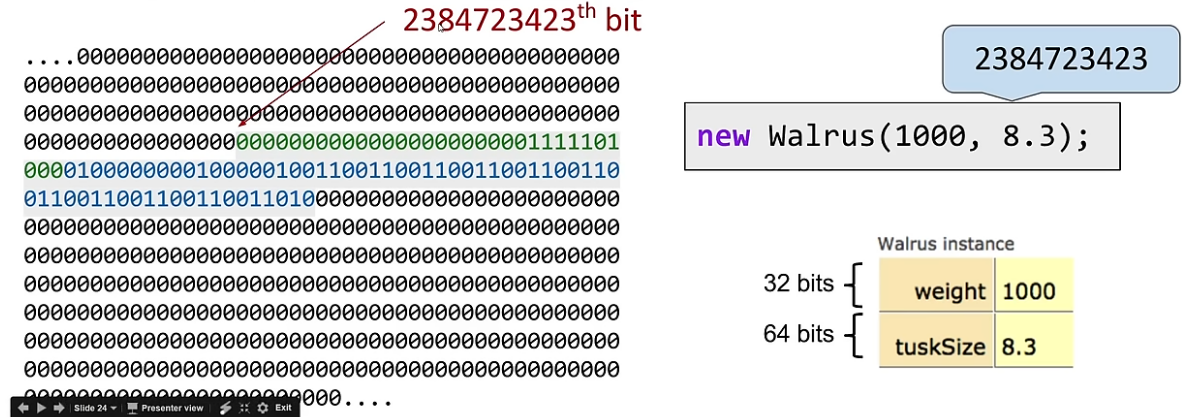
When we instantiate(new) an Object (e.g. Dog, Walrus, Planet):
- Java first allocates a box of bits for each instance variable of the class and fills them with a default value (e.g. 0, null).
- The constructor then usually fills every such box with some other value.
Can think of new as returning the address of the newly created object
- Addresses in Java are 64 bits.
- Example (rough picture): If object is created in memory location
So the
new- allocating memory and returning the address, similar to themallocin C.
Reference Type Variable Declarations
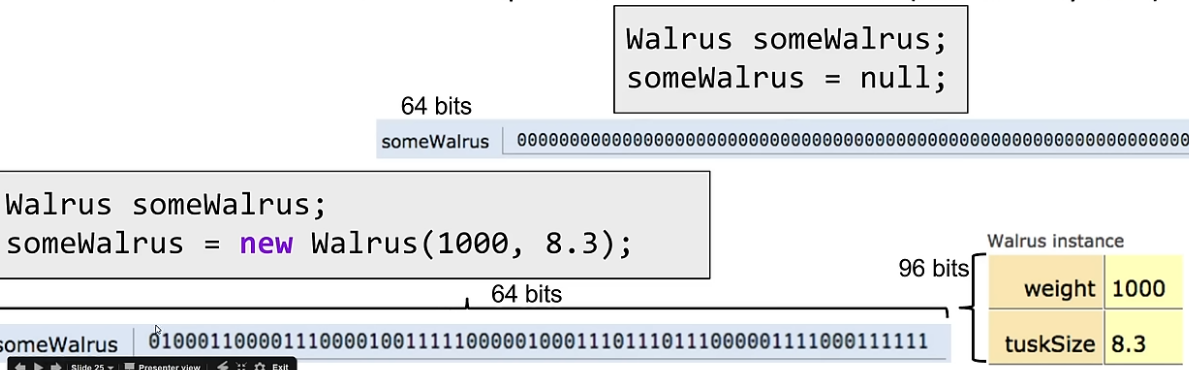
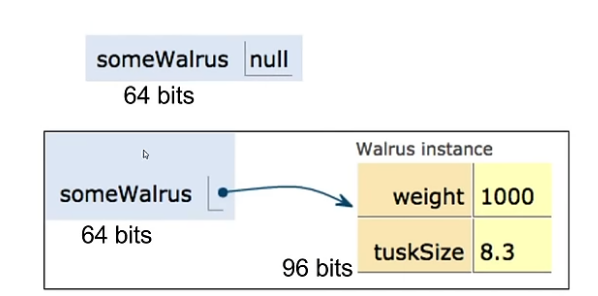
When we declare a variable of any reference type (Walrus, Dog, Planet):
- Java allocates exactly a box of size 64 bits, no matter what type of object.
- These bits can be either set to:
- Null (all zeros).
- The 64 bit “address” of a specific instance of that class (returned by new).
The Golden Rule of Equals(GRoE) (and Parameter Passing)
y = x copies all the bits (pass by value) from x into y.
So does reference types, in terms of our visual metaphor, we “copy” the arrow by making the arrow in the b box point at the same instance as a.
Summary
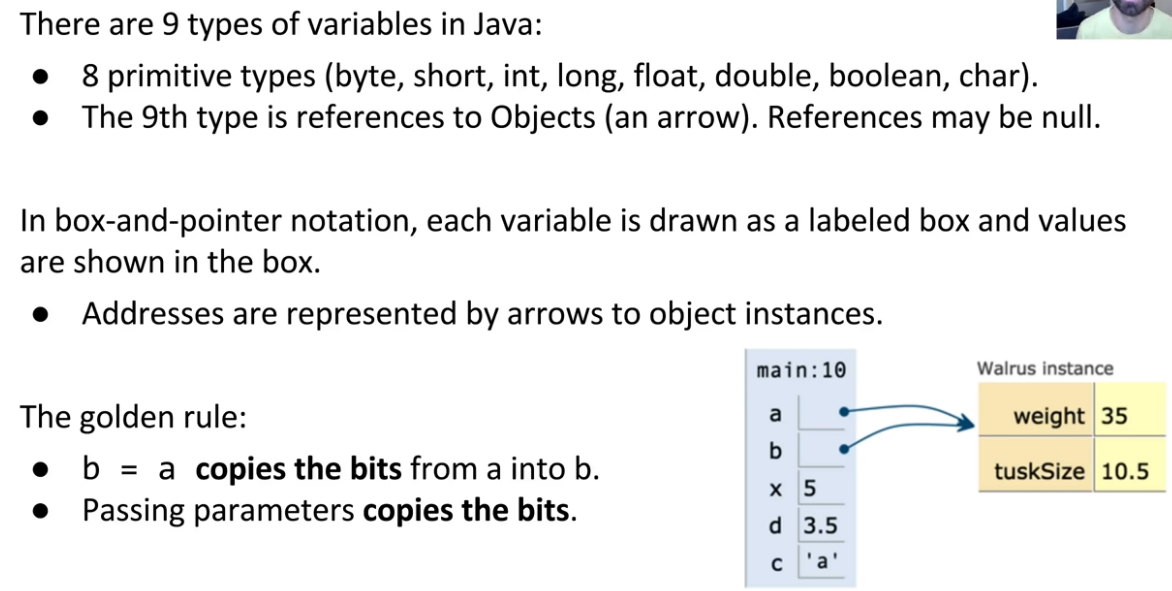 (Variables that store arrays are reference variables just like any other.)