Overloading
Java allows multiple methods with same name, but different parameters or different signatures.
shorthand:
It need repeating a method many times, which is verbose and terrible for us to maintain our codes.
[Inheritance]
Hypernym
interface: Keyword instead of class
Idea: interface is a specification of what a class should do, not how to do it.
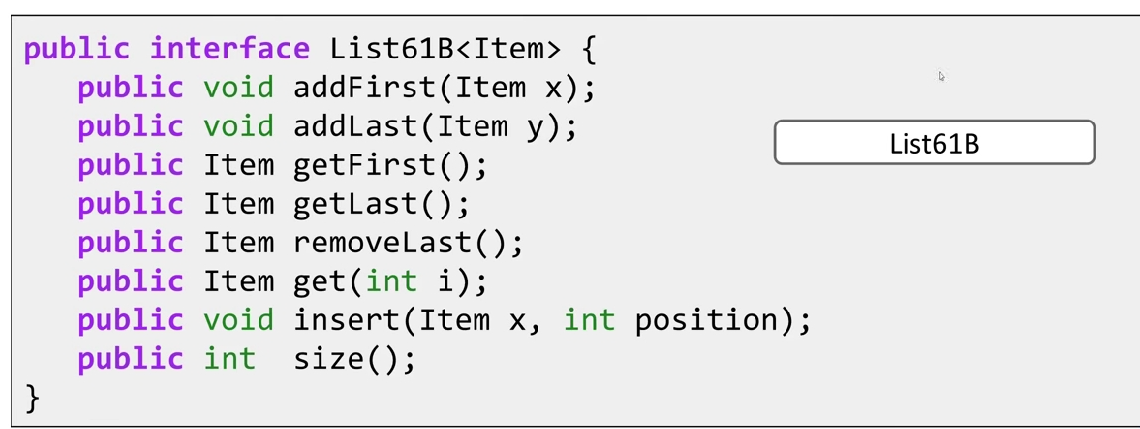 Every method in interface should be public so
 public is redundant.
implements: Keyword to tell compiler that it is a hyponym of interface(a subclass)
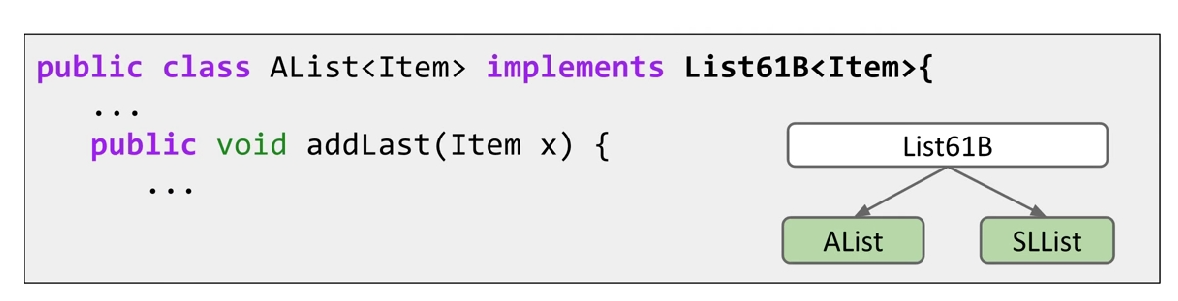
A class or an interface can implements more than one interface.Subtype Polymorphism
Overriding vs. Overloading
Definition
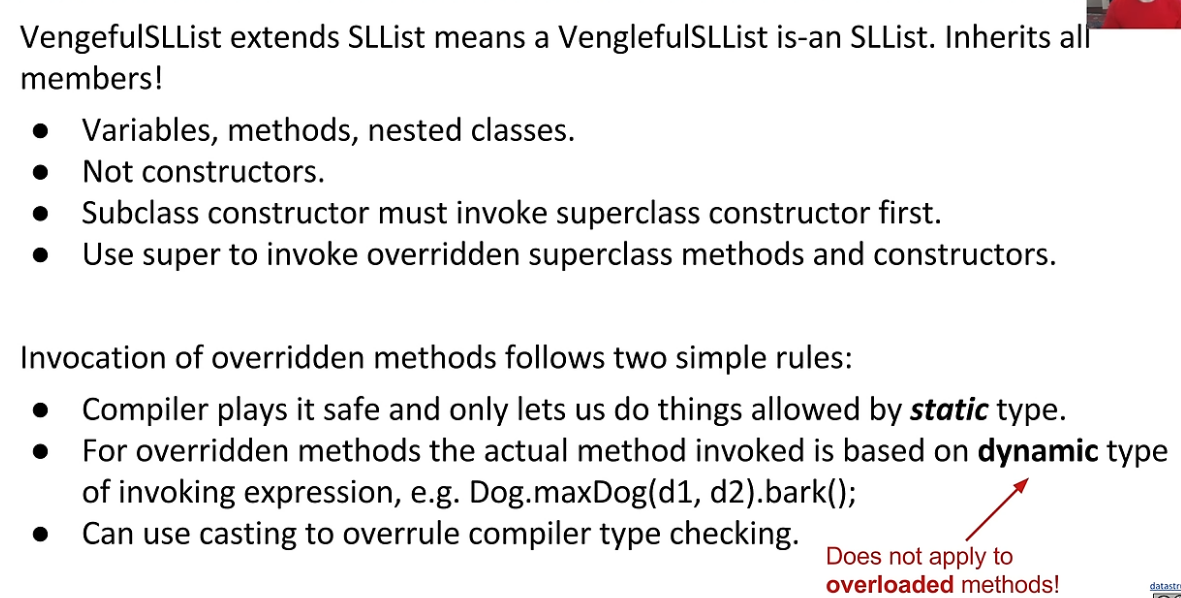
If a subclass has a method with the exact same signature as in the superclass, we say the subclass overrides the method, which happens only in the situation of inheritance.
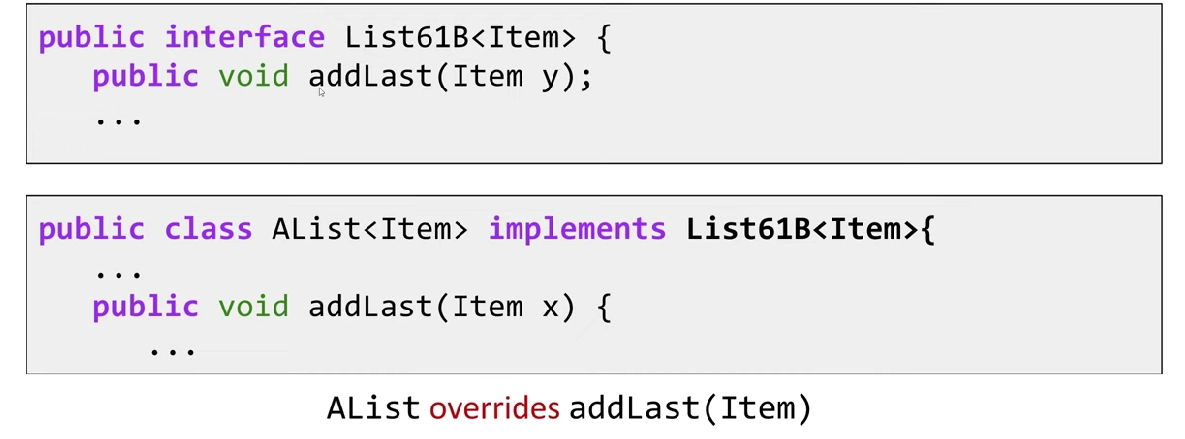
But in the subclass extending this class, when overriding, return type could be the subclass of the return type of the superclass method.
(Covariant Return Types)
class Parent {
    public Number getNumber() { // 父类返回Number
        return 0;
    }
}

class Child extends Parent {
    @Override
    public Integer getNumber() { // 子类返回Integer(Number的子类)
        return 1;
    }
}
On the other hand, method with the same name but different signatures are overloaded.
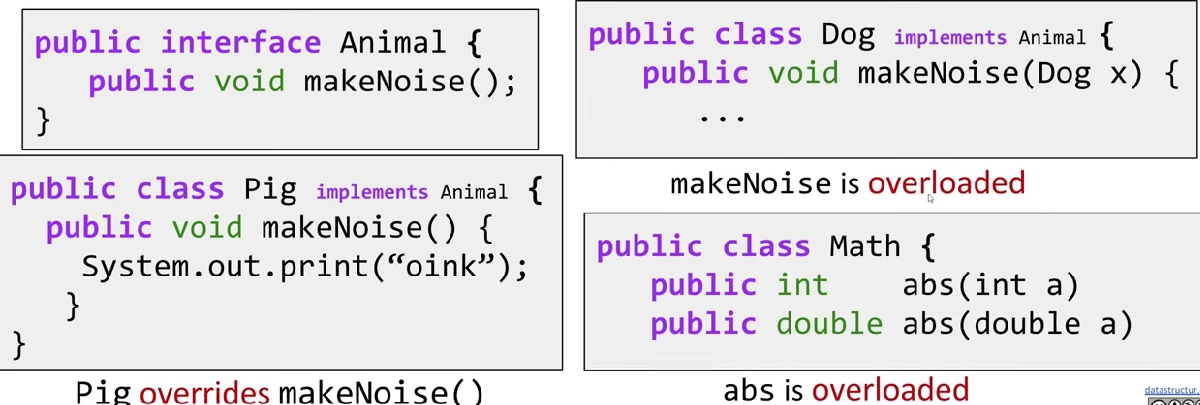 The conception of overload can be also applied in the situation without inheritance.
@Override(Optional, but Recommended)
An annotation marks that the method is an overriding method, the only effect is that the code won’t compile if it is not actual an overriding method.
- Even if you don’t write @Override, subclass still overrides the method.
- @Override is just an optional reminder that you’re overriding.
Why use @Override?
- Main reason: Protects against typos.
- If you say @Override, but it the method isn’t actually overriding anything, you’ll get a compile error.
- e.g.
public void addLats(Item x)
- Reminds programmer that method definition came from somewhere higher up in the inheritance hierarchy.
Interface inheritance(What can do?)
Specifying the capabilities of a subclass using the implements
keyword is known as interface inheritance.
- Interface: The list of all method signatures.
- Specifies what the subclass can do, but not how.
- Classes must override all of these methods!
- Will fail to compile otherwise.
- Can provide variables, but they should be
public static final.finalmeans never changing, constant value(constin C).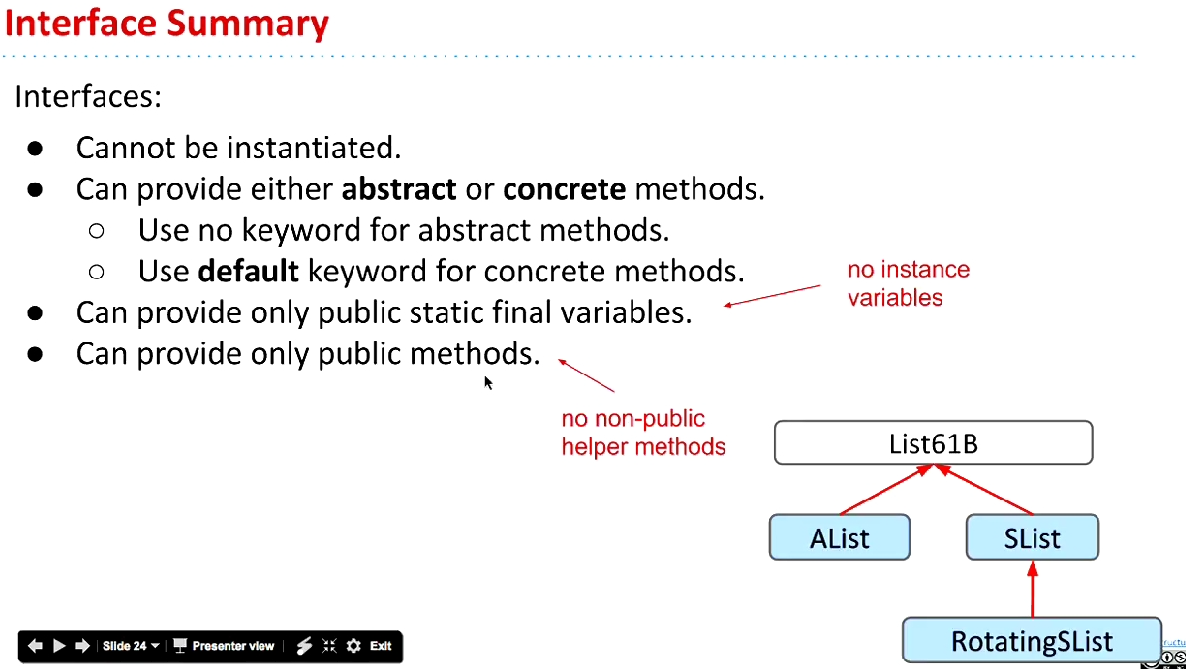
(A variable of superclass can hold addresses of a variable of subclass and the variable can call the method of this exact subclass)
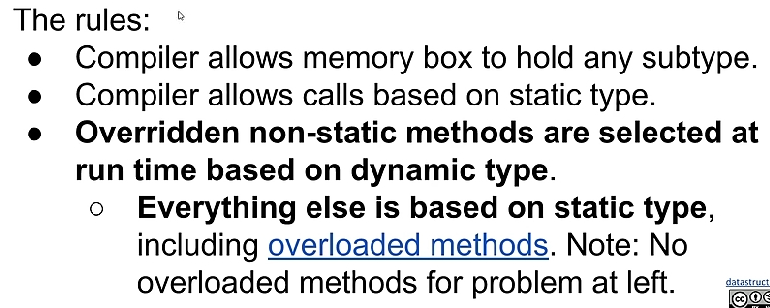
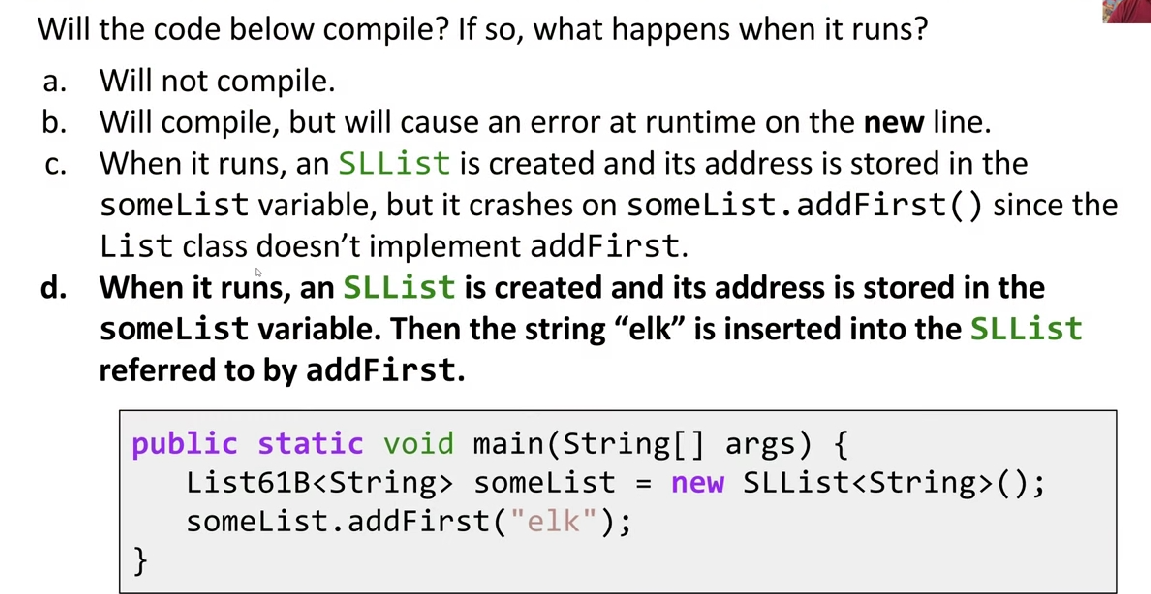 This phenomenon is a key manifestation of polymorphism in Java. Here’s the breakdown:
Compile-time: Focus on the declared type (Parent class)
When we write code like List61B<String> someList = new SLList<String>();, during compilation, the compiler only cares about the declared type of the variable (here, List61B). As long as the addFirst method is declared in List61B (regardless of its actual implementation), the compiler considers the call someList.addFirst("elk") legal and won’t report an error.
In other words, at compile - time, it “follows the contract of the parent class”.
Run-time: Focus on the actual object (Child class)
When the code actually runs, the JVM will detect that someList actually points to an SLList object. So, when calling the method, it will dynamically find the specific implementation of addFirst in SLList (even if the parent class List61B only declares this method without a real implementation).
That is, at run - time, it “follows the implementation of the child class”.
In short:
- At compile - time, it depends on the declared type of the variable (the parent class constrains whether a method call is “legal”).
- At run - time, it depends on the actually created object (the child class determines how a method is “executed”).
This is the power of polymorphism:
We can write code using a unified parent class interface, yet flexibly invoke the specific logic of child classes. This makes the program more extensible. For example, if we want to replace SLList with another child class of List61B (say AnotherList which also implements addFirst), we just need to change new SLList() to new AnotherList(), without modifying the calling logic.
Implementation Inheritance(How to do?)
For better or worse, Java also allows implementation inheritance: Subclasses can inherit signature AND implementation.(like Python)
That is, we can have a body for the methods in a interface!
Use the default keyword to specify a method that subclasses should inherit from an interface.
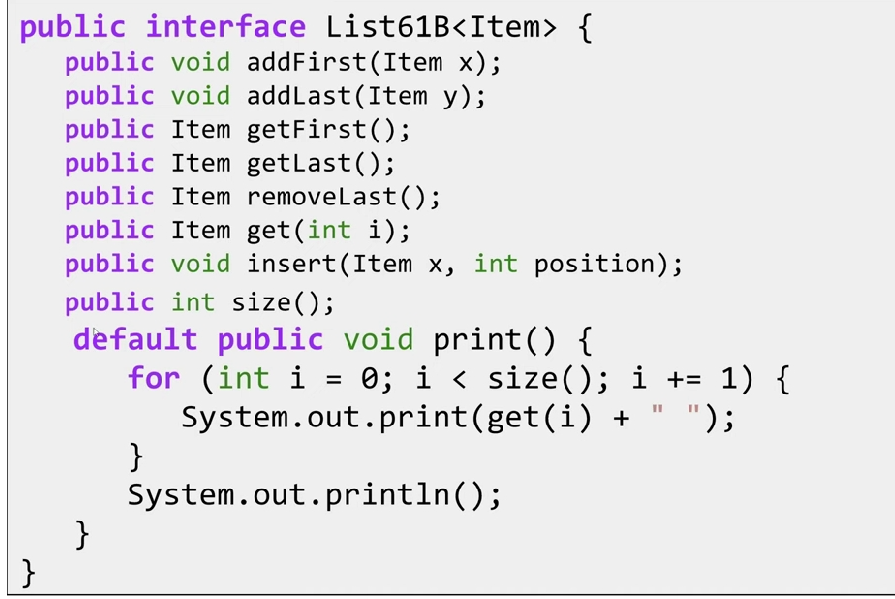 And we can override the default method as well. Same as above, when we store a variable of subclass in a variable of superclass, we will still call the method of overriding method of the subclass.
So methods in interface can be divided into two kinds: abstract methods(without verbose keyword) and default method(with keyword default).
Extends
If we want one class to be hyponym of another class, use it.
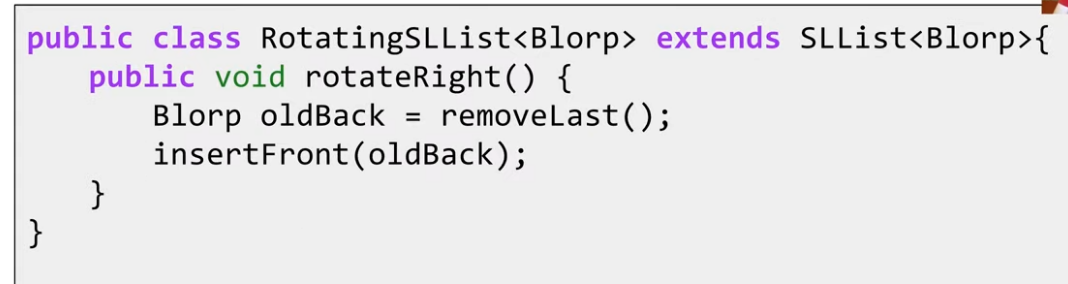 Because of
 extends, RotatingSLList inherits all members of SLList:
- All instance and static variables.
- All methods.
- All nested classes.
But members may be private and inaccessible.
Constructors are not inherited.
Abstract Classes
super
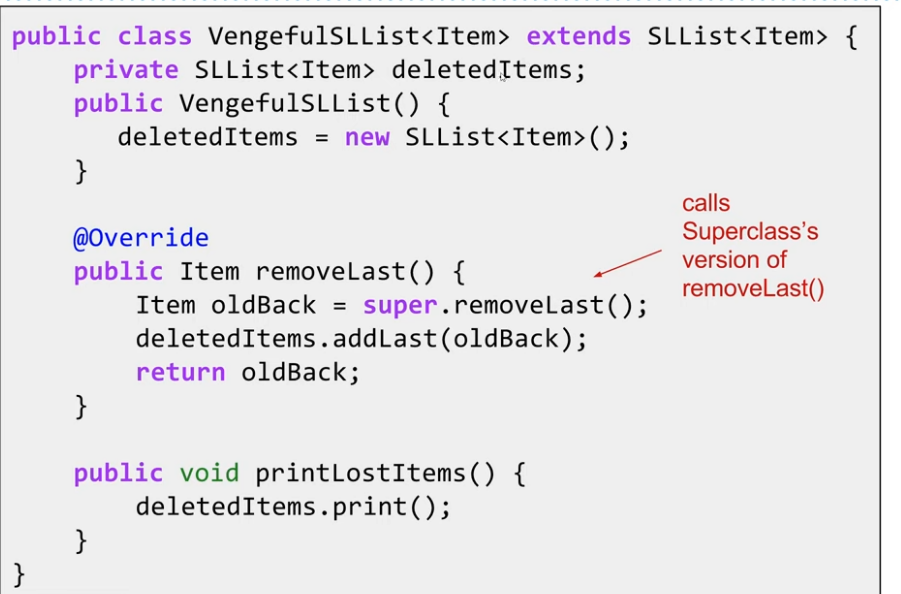
A keyword that can call private methods or attributes of the superclass.
Constructor Behavior Between Superclass and Subclass
Constructors are not inherited.
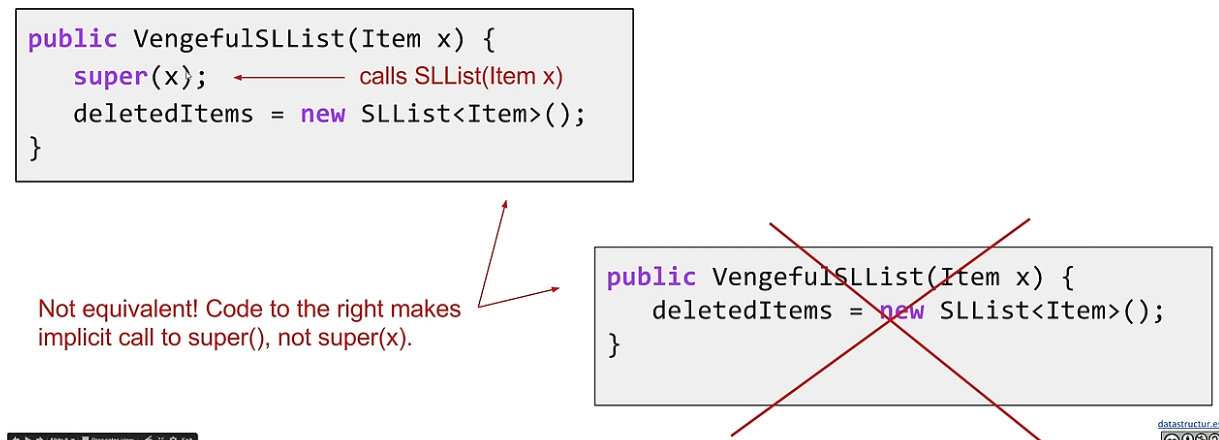
However, the rules of Java say that all constructors must start with a call to one of the super class’s constructors.
- Idea: If every
VengefulSLListis-aSLList, everyVengefulSLListmust be set up like anSLList.- If you didn’t call
SLListconstructor, sentinel would be null. Very bad.
- If you didn’t call
- You can explicitly call the constructor with the keyword super (no dot).
- If you don’t explicitly call the constructor, Java will automatically do it for you.

If we want to use a super constructor other than the no-argument constructor, can give parameters to super. In other word, call super(x) explicitly.
Dynamic Method Selection
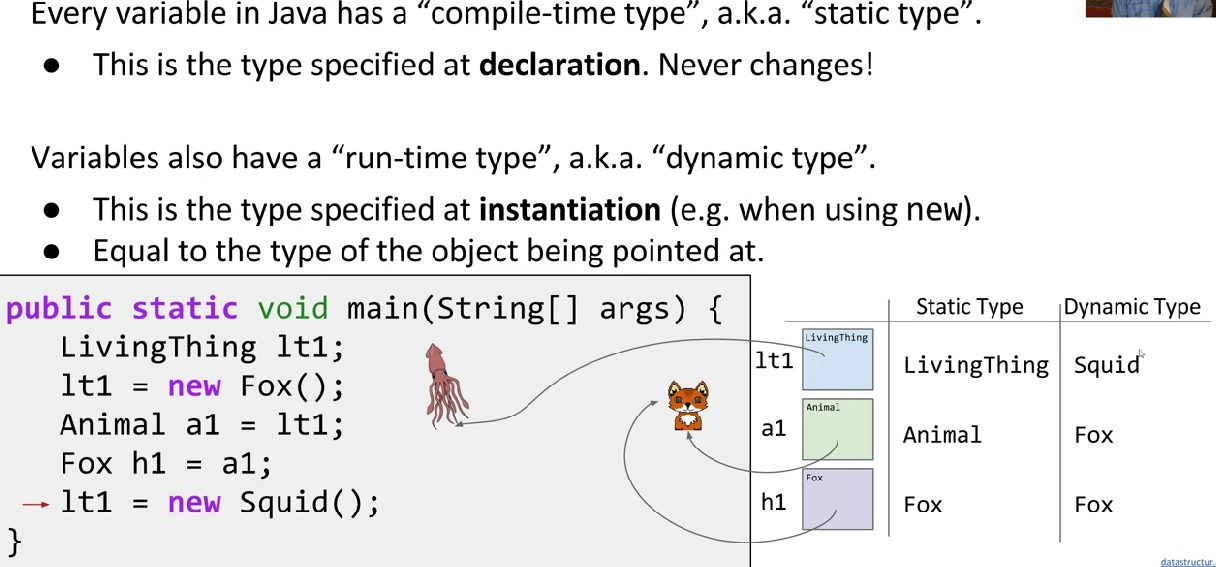 So if the run-time type overrides the method of compile-time type, the run-time type’s method will be used instead.
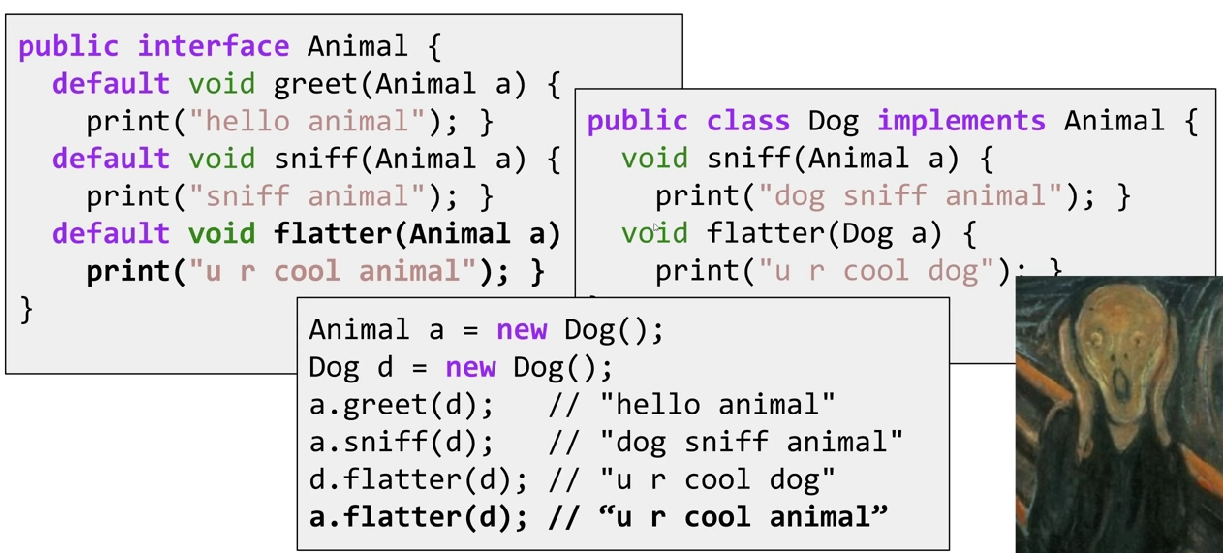
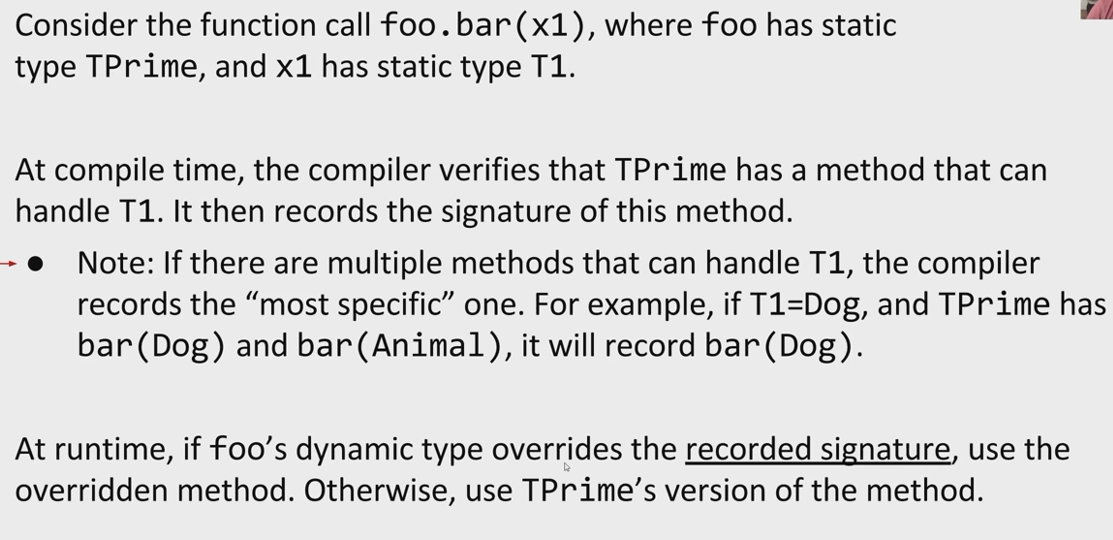 Actually, if there are many layers of inheritance, Java will search for overridden method from the dynamic type until the root - the biggest superclass.
Just like how python find variables, methods, attributes in frames.
Summary
Interface Inheritance (a.k.a. what):
- Allows you to generalize code in a powerful, simple way.
Implementation Inheritance (a.k.a. how):
- Allows code - reuse: Subclasses can rely on superclasses or interfaces.
- Example: print() implemented in List61B.java.
- Gives another dimension of control to subclass designers: Can decide whether or not to override default implementations.
Important: In both cases, we specify “is-a” relationships, not “has-a”(composition).
- Good: Dog implements Animal, SLList implements List61B.
- Bad: Cat implements Claw, Set implements SLList.
Encapsulation, Type Checking and Casting are also related to this notes.
The Object Class
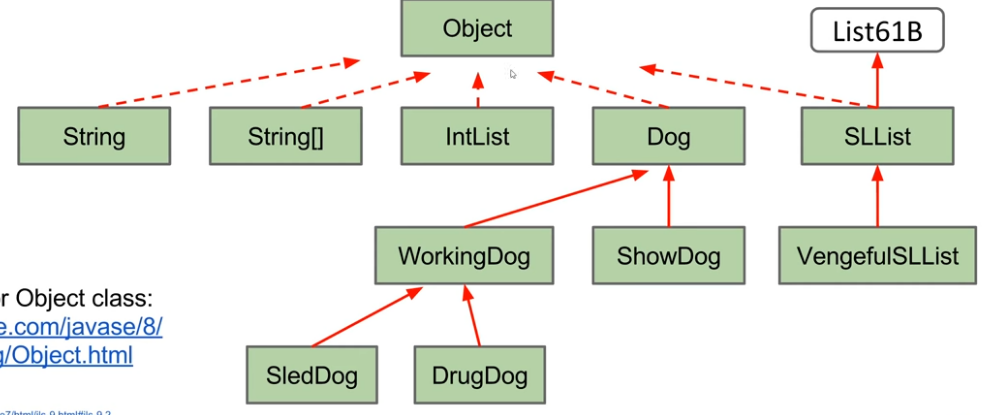
Every type in Java is a descendant of the Object class.
Every class without using extends explicitly actually extends Object class implicitly.
But interface does not extend the Object class.
equalshashCodetoString