In contrast to an array which is of fixed size , a list is able to grow arbitrarily large.
IntList
Linked Lists
Two Variable:
int first;IntList rest;Strange, naked for Java.
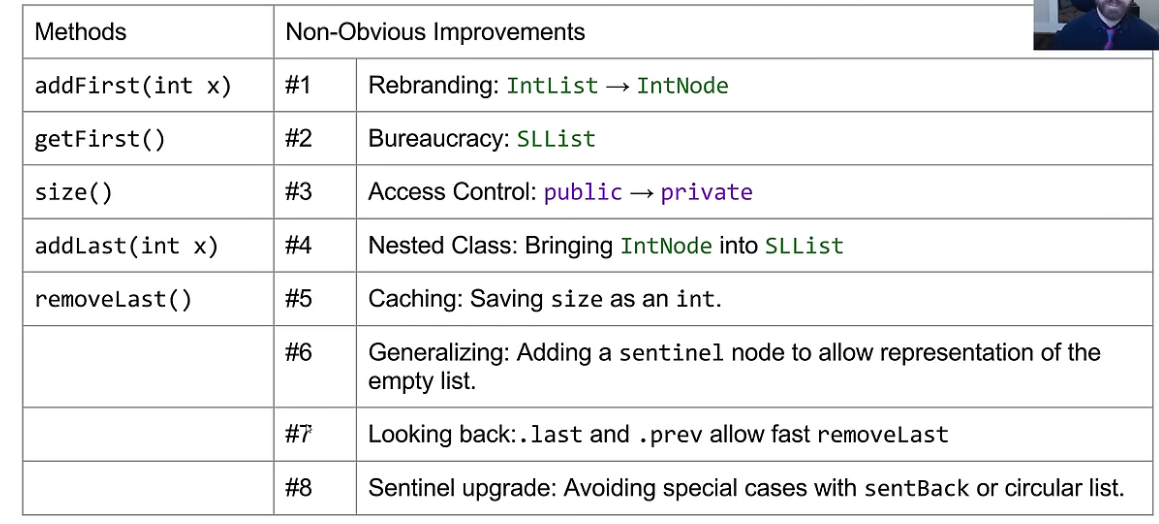
SLList(Single Linked List)
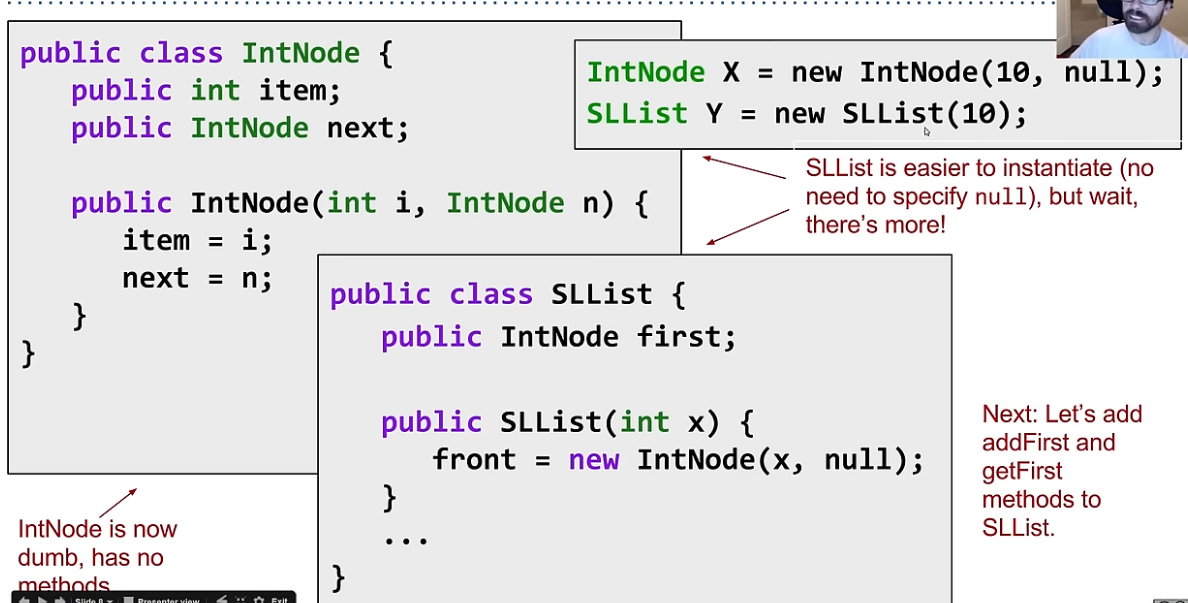
public class IntNode {
    public int item;
    public IntNode next;

    public IntNode(int i, IntNode n) {
        item = i;
        next = n;
    }
}
public class SLList {
public IntNode first;
public SLList(int x) {
first = new IntNode(x, null);
}
}
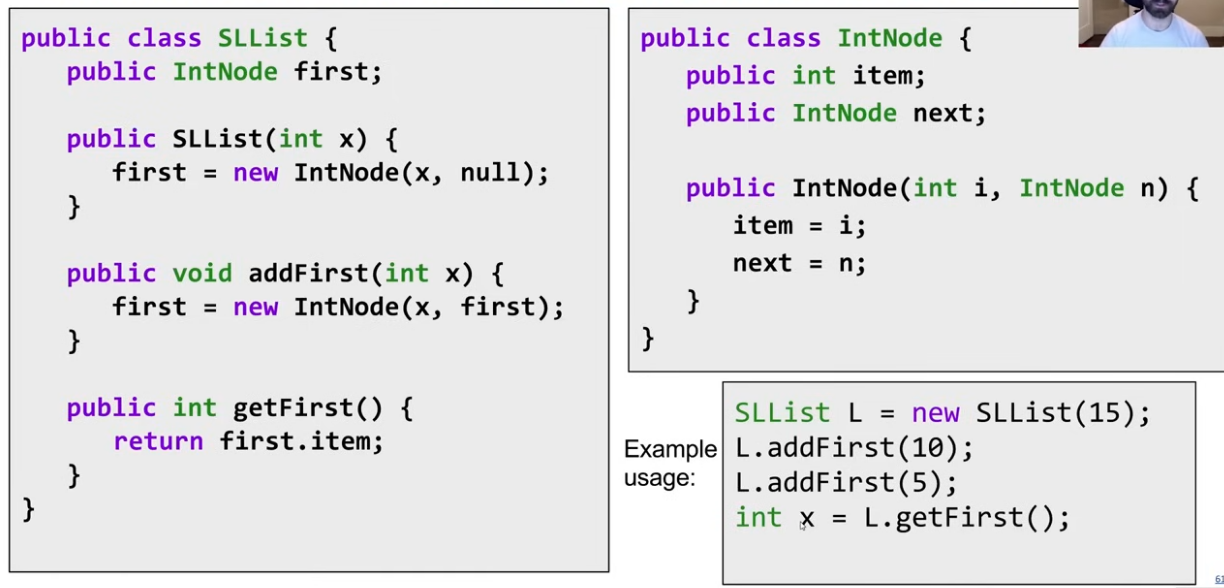
SLList vs IntList
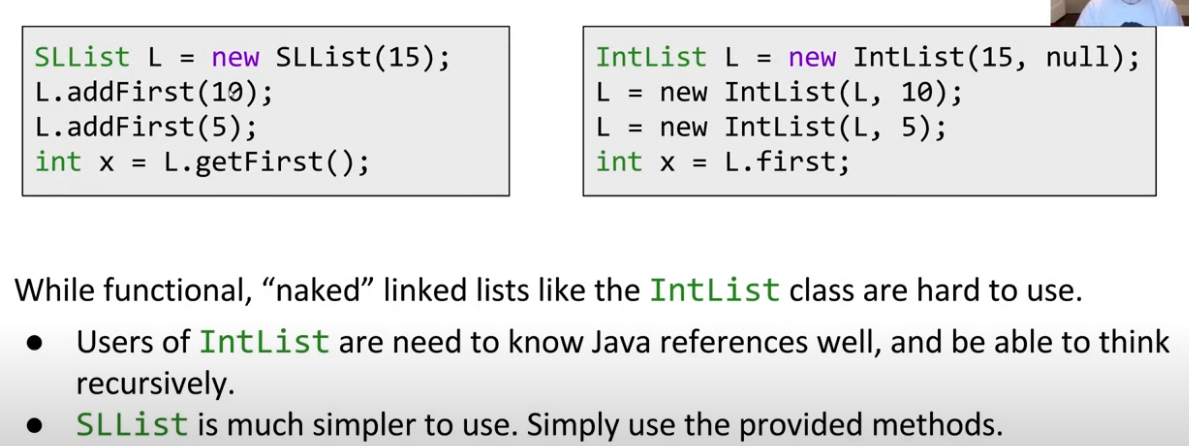
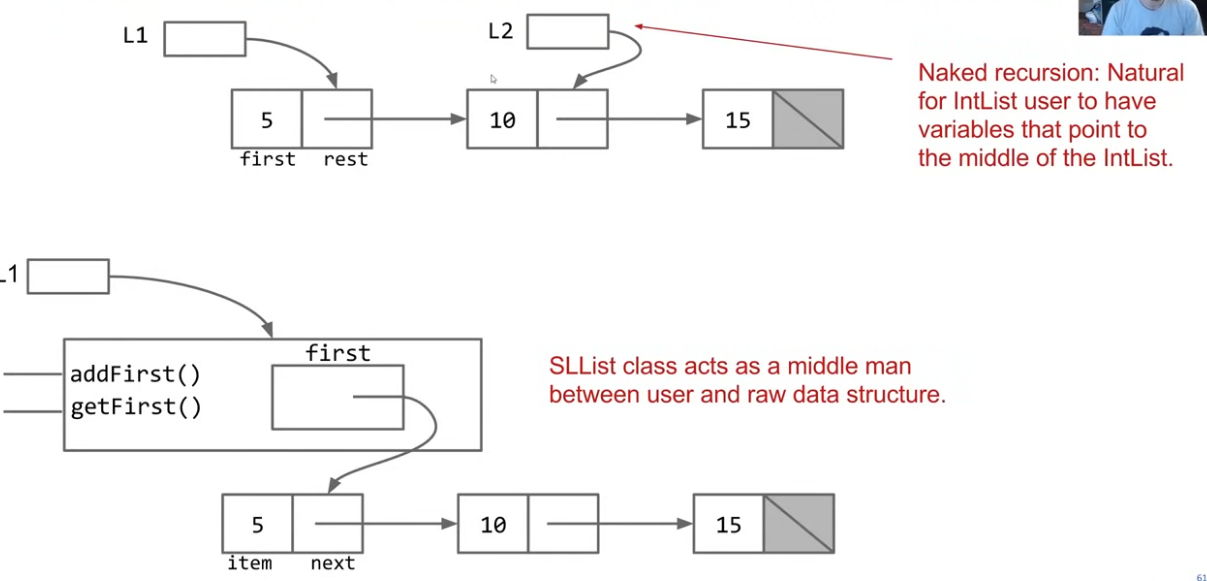
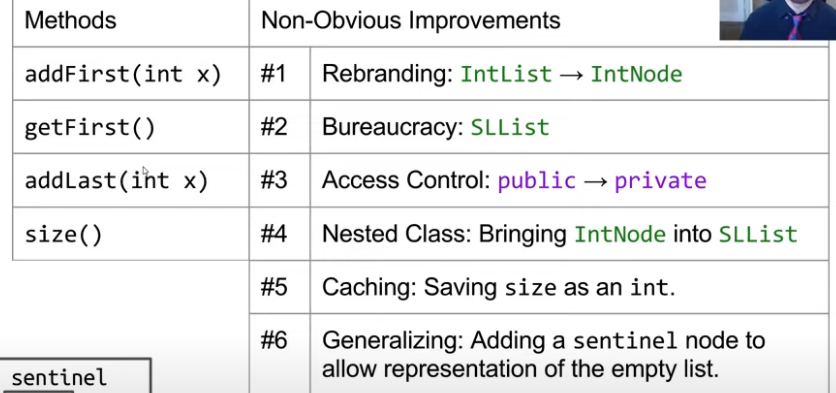
Cache
Set a variable keeping track of the size of list, we size() is called, return it.
→ Save time.
Easy to Use(Data Abstraction Barrier)
Be Able to Represent Empty List
More Optimize: Sentinel Node
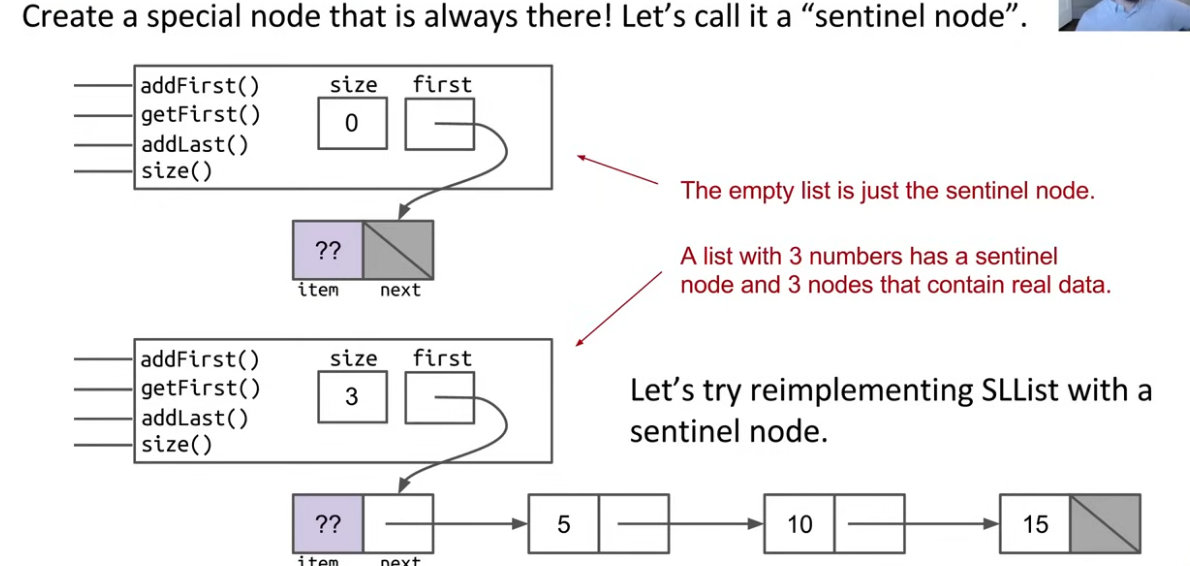
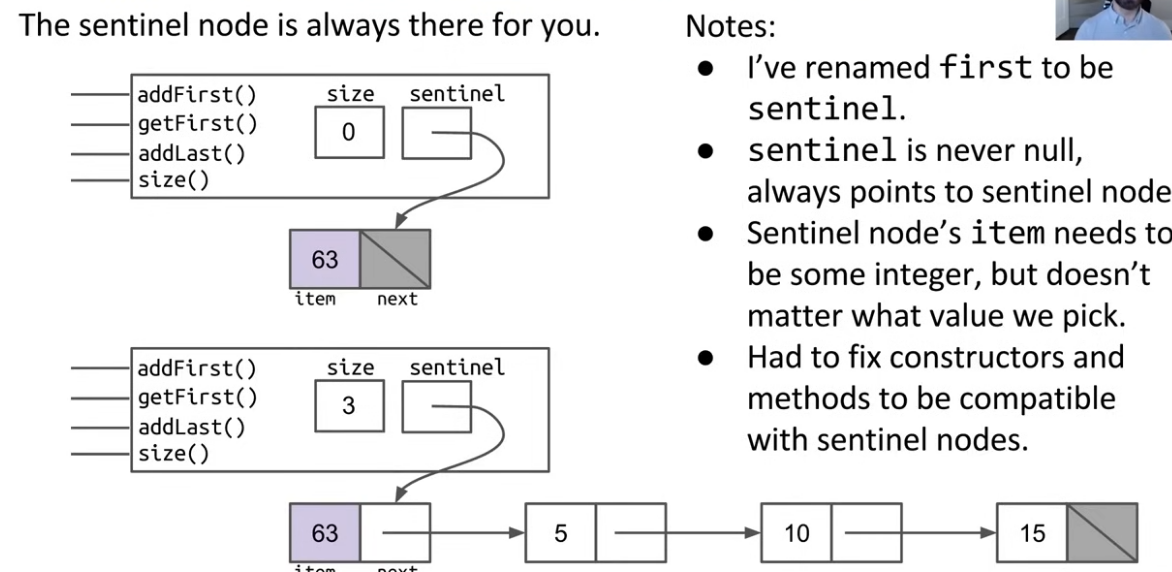
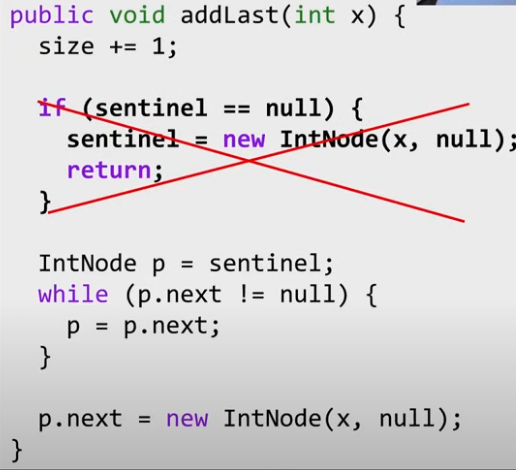
No need for special cases!
The Final Code
 /** An SLList is a list of integers, which hides the terrible truth
   * of the nakedness within. */
public class SLList {
    private static class IntNode {
        public int item;
        public IntNode next;

        public IntNode(int i, IntNode n) {
            item = i;
            next = n;
        }
    }

    /* The first item (if it exists) is at sentinel.next. */
    private IntNode sentinel;
    private int size;

    /** Creates an empty SLList. */
    public SLList() {
        sentinel = new IntNode(63, null);
        size = 0;
    }

    public SLList(int x) {
        sentinel = new IntNode(63, null);
        sentinel.next = new IntNode(x, null);
        size = 1;
    }

     /** Adds x to the front of the list. */
     public void addFirst(int x) {
         sentinel.next = new IntNode(x, sentinel.next);
         size = size + 1;
     }

     /** Returns the first item in the list. */
     public int getFirst() {
         return sentinel.next.item;
     }

     /** Adds x to the end of the list. */
     public void addLast(int x) {
         size = size + 1;

         IntNode p = sentinel;

         /* Advance p to the end of the list. */
         while (p.next != null) {
             p = p.next;
         }

         p.next = new IntNode(x, null);
     }

     /** Returns the size of the list. */
     public int size() {
         return size;
     }
}
Invariant
An invariant is a condition that is guaranteed to be true during code execute (assuming there are no bugs in your code).
An SLList with a sentinel node has at least the following invariants:
- The sentinel reference always points to a sentinel node.
- The first node (if it exists), is always at sentinel.next.
- The size variable is always the total number of items that have been added.
Invariants make it easier to reason about code:
- Can assume they are true to simplify code (e.g.
addLastdoesn’t need to worry about nulls). - Must ensure that methods preserve invariants.
DLList(Double Link List)(with Circular)
Generic List
- In the .java file implementing your data structure, specify your “generic type” only once at the very top of the file.
- In .java files that use your data structure, specify desired type once:
- Write out desired type during declaration.
- Use the empty diamond operator <> during instantiation.
- When declaring or instantiating your data structure, use the reference type.
- int: Integer
- double: Double
- char: Character
- boolean: Boolean
public class DLList<BleepBlorp> {
    private IntNode sentinel;
    private int size;

    public class IntNode {
        public IntNode prev;
        public BleepBlorp item;
        public IntNode next;
        ...
    }
    ...
}


DLList<String> d2 = new DLList<>("hello");
d2.addLast("world");
AList(Array Based List)
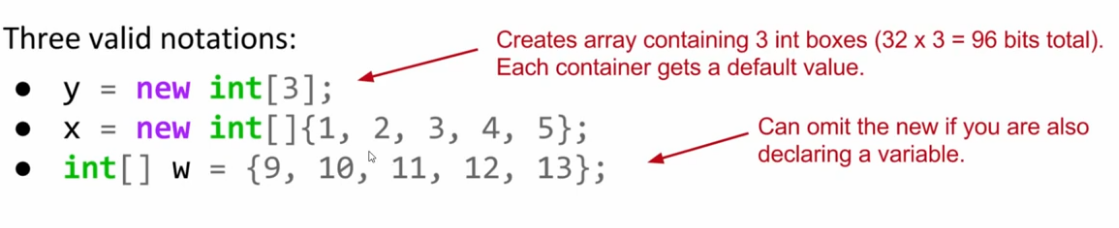
Arrays are a special kind of object which consists of a numbered sequence of memory boxes.
Arrays consist of:
- A fixed integer length (cannot change!)
- A sequence of N memory boxes where N=length, such that:
- All of the boxes hold the same type of value (and have same # of bits).
- The boxes are numbered 0 through length-1.
Like instances of classes:
- You get one reference when its created.
- If you reassign all variables containing that reference, you can never get the array back.
Unlike classes, arrays do not have methods.
Array Copy
2D Array
Rather than 2D array in C, it is more similar to pointer array in C.
Syntax:
int[][] twoDimension = new int[4][];It creates an array whose length is 4 and each box can contain a 64 bits reference of another array of integer.
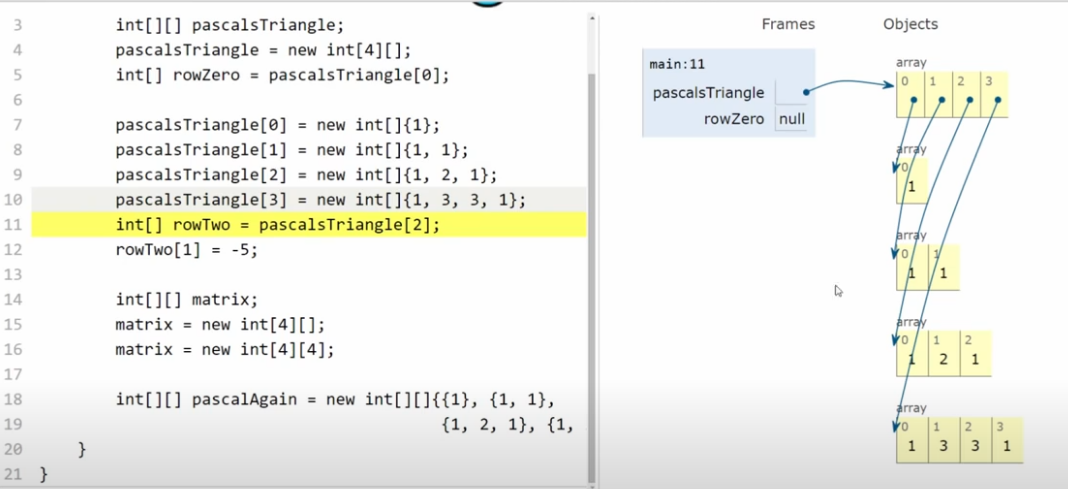
int[][] matrix = new int[4][4];It creates an array of 4 boxes and each one contains an array of 4 boxes fixed. Not only the array integer reference but actual integer array.

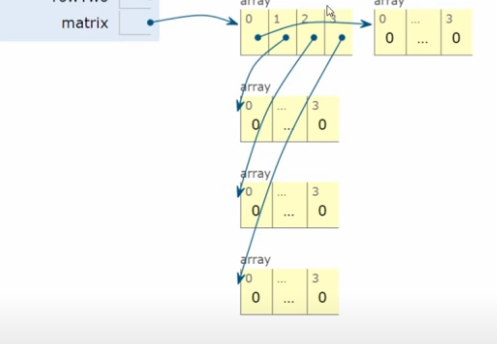 Initialize:

Array vs Class
Arrays and Classes can both be used to organize a bunch of memory boxes.
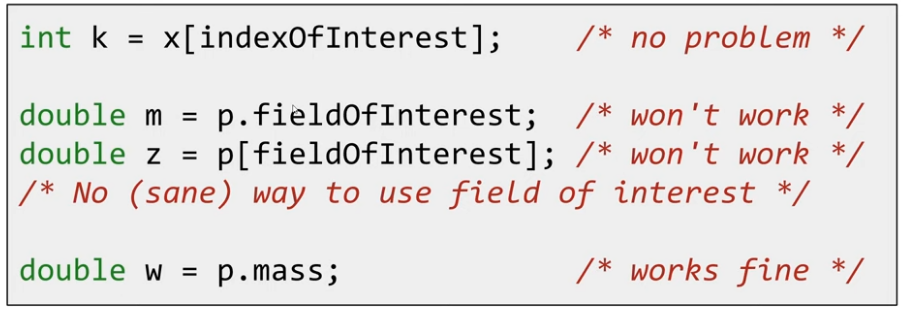
- Array boxes are accessed using [] notation.
- Class boxes are accessed using dot notation.
- Array boxes must all be of the same type.
- Class boxes may be of different types.
- Both have a fixed number of boxes.
- Array indices can be computed at runtime.
- Class member variable names can’t be computed and used at runtime.(The only way to access a member of a class is with hard-code dot notation)
“Resizing” Arrays
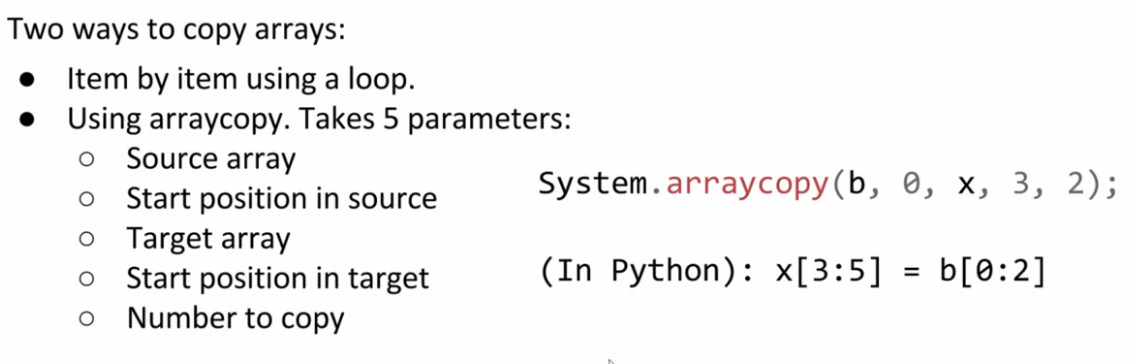
int[] a = new int[size + 1];
System.arraycopy(a, 0, item, 0, size);
a[size] = ...;
item = a;
size++;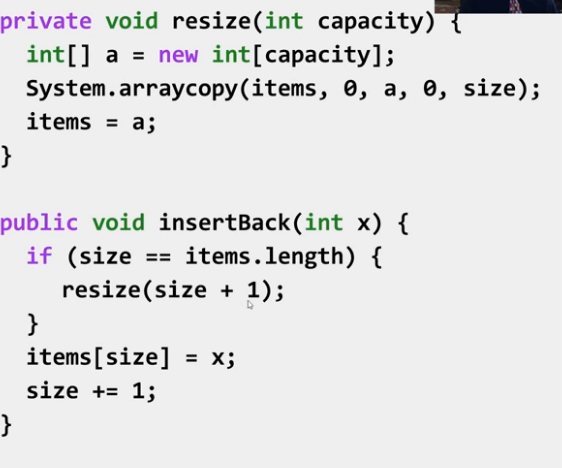
Trade-off Between Time and Memory Efficiency
Speed Up
public void insertBack(int x) {
    if(size == item.length) {
        resize(size * 2);
    }
    ...
}
Memory Efficiency
An AList should not only be efficient in time, but also efficient in space.
- Define the “usage ratio” R = size / items.length;
- Typical solution: Half array size when R < 0.25.
Generic
Creating generic arrays are not allowed in Java, instead we use Object and cast.
public class AList<Item> {
    private Item[] items;
    private int size;
    public AList() {
        items = (Item[]) new Object[100];
        ...
    }
    ...
    {
        Item[] a = (Item[]) new Object[capacity];
        ...
    }
    ...
}
Another fix:
基本类型(如
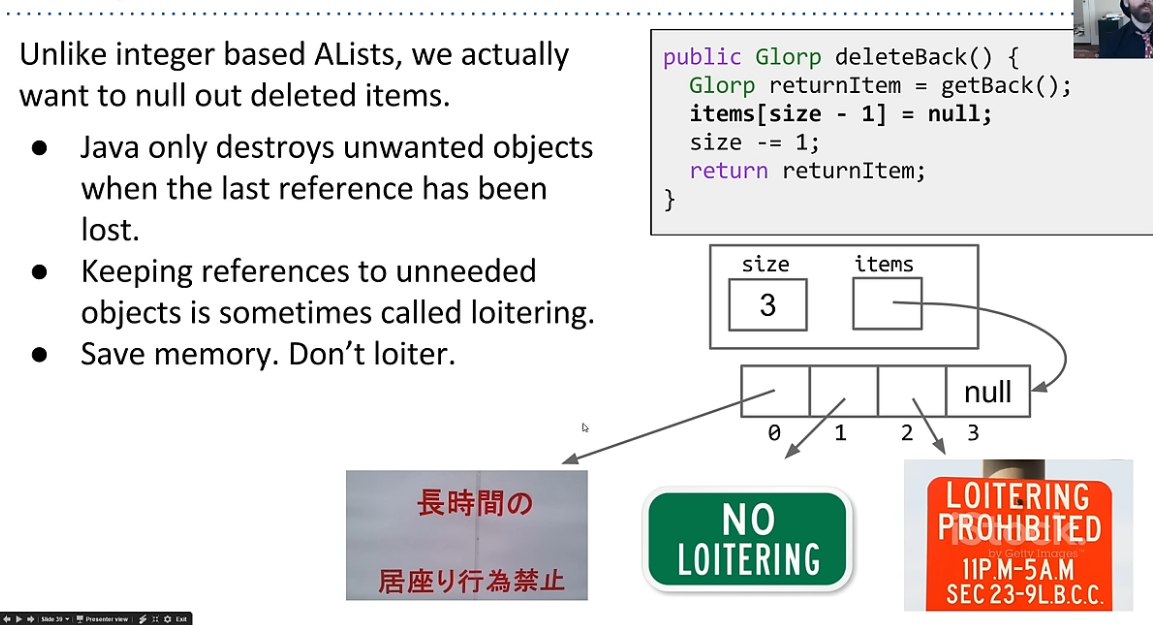
int、boolean) 在 Java 中,int、boolean等属于基本数据类型,它们不是引用类型。当数组存储这些基本类型的数据时,数组元素直接存储的就是具体的值,而不是指向某个对象的引用。 当从数组中 “删除” 一个基本类型元素(比如通过改变数组的有效长度来实现逻辑删除),虽然被 “删除” 位置上的值还在数组的内存空间中,但由于基本类型数据本身占用的空间是固定且直接存储值的,不存在对象引用导致的内存无法回收问题, 并且当后续对数组进行操作(比如重新赋值等),原有的值就会被覆盖。从内存占用的角度来说,不需要将其显式设置为类似null的值(基本类型也没有null这种状态 ),也不会造成内存浪费,因为它们没有引用其他对象,不存在游离对象的情况。
引用类型(对象) 当数组存储的是对象这种引用类型的数据时,数组元素存储的是对象的引用,即指向对象在堆内存中地址的指针。 如果只是进行 “假删除”,比如仅仅更改表示数组有效长度的索引,而不将对应位置的引用设置为
null,那么这个被 “删除” 的对象依然会被数组中的引用指向。由于 Java 的垃圾回收机制只有在对象的所有引用都被释放(即没有任何变量指向该对象)时,才会回收该对象所占用的内存,所以此时这个对象虽然在逻辑上已经不属于数组要管理的数据了,但依然无法被垃圾回收,从而造成内存的浪费,这种情况就是所谓的 “对象游离(loitering)” 。只有将数组中对应位置的引用设置为null,切断对该对象的引用,垃圾回收器才能够在合适的时机回收该对象占用的内存。